Category Archives: Posts

Analysis of an Ad: Shane Benvin

The speaker of this ad is a company called “hulu”. Hulu is a website that streams shows and movies. By saying: “More shows & movies than your desire to go out tonight,” they’re trying to convince you that you’ll enjoy your time more at home watching something than going out. The ad presents themselves in a simple way by using their simple colors green and black.

The ad is arguing and trying to state that you’ll decide to watch shows and movies on their site more than going out. They are also claiming they have a lot of choices to choose from by saying: “More shows & movies.”

The ad relies on the assumption that you’re into watching movies and shows. The intended audience of the ad would be people who like staying home and watching things. Most likely this ad would attract high school and college students whom are usually taking the train every day for school or even work because it would help the time go by for them. I know this because most of my friends have a hulu accounts and are into watching a various shows and movies.

This ad is trying to persuade the audience by saying ”  More shows and more movies than your desire to go out tonight” which means hulu has a large variety of shows and movies that people can choose from and watch all night . They are trying to convince you that it’s better to watch hulu than go out.

This ad lacks ethos and logos but it has a little bit of Pathos. This ad shows alittle bit of pathos to persuade the audience when they said ” than your desire to go out tonight” because the word desire shows the emotional aspect of this ad. When people say desire it means a really strong meaning to have something.

I do not think this ad is very effective because I think this ad needs to stand out more. Maybe they can display some popular movies and TV shows that people have heard of so they would be more interested into buying Hulu.



Analysis of Ad-Keshona Sylvester

In this ad, the speaker is probably someone that works for the company Seamless. I came to this conclusion because the person that made the ad is trying to convince others to use the app Seamless. The speaker is presenting themselves as convincing. The speaker wants us to feel a little guilt trip into saving money on food by using Seamless. I know this because the speaker starts off by stating that we save money by “borrowing” our neighbor’s internet when we should save money on food.

The message that the speaker is trying to convey is that Seamless is a good app to order food online and save money while doing so. The assumption that the ad relies on is that we “borrow” our neighbors internet and we save money by doing so. 

I think that this ad is intended for young adults. Young adults are usually the ones big on the use of internet so they feel the need to “borrow” their neighbors internet because they might not want to or be able to get their own internet. For example, I always use apps like Seamless to order food because there’s always discount codes. On the other hand, the adults around me usually cook or go outside to get food. Also, young adults are more likely to want to order food online and save money while doing so. Adults can also be the audience but mostly adults that like to save money on things. 

A strategy that the speaker used is using real life to convince us to do something. The speaker uses Ethos as a way to persuade people to use the app. The speaker basically states that this app can save people money, giving credibility to the app. 

I think the ad is effective. I think so because no one can possibly turn down getting food delivered to them without having to go outside. Also, the majority of people like to get discounts to save themselves money on things.

Analysis of an Ad: Jalen Nimmons

The speaker in the add is a group called Rise. They are trying to present themselves as “activists”. A group of people trying to spread awareness of racism in America. I am able to tell this by the title “Don’t want to get stopped by the NYPD” as an African-American teenager in America. Also, as a young African-American witnessing other young African-American males being stopped and questioned by white police officers for no reason.

This message this add is trying to convey is African-Americans are the main victim of police harassment and that no matter how good or how rich you are if your skin is “black” you can always become the next victim of police harassment.

The intended audience is for the community especially young African-American males. They need to be aware of the challenges life has to offer them and what they may encounter while growing up in this world based on the color of their skin. Also, it’s used to gain unity within communities around the world dealing with this injustice.

One method of persuasion the ad used was the color “blue“. The color blue is associated to tears, hence sadness. This trigger in the brain can cause sympathy for the victim and the “cause”. Also, brought about was the fact that several African-American young males were stopped on the street and while driving for contraband or weapons and had neither were found. This indicated innocent males of color were stopped for one apparent reason, the color their skin.

This ad appeals to pathos because as you know some people are not able to walk away from police interaction alive. This message of people of color being targeted due to their color creates a lot of concern and worry within the African-American community and their homes. This ad appeals to logos by putting true statics of police stops and their finding mostly nothing in dominant black areas. This has ethos because these numbers come from the government of the year 2010 and not from the group Rise.

This ad is effective because it’s spreading awareness of the ugly truth in America, the ugly truth that racism still exists. It’s unfortunate that the legal system set up to protect citizens of America is the same system crippling African-Americans. We have to prepare our youth to deal with these challenges so they won’t become the next victim and hopefully gain enough support to change this on-going attack by cops who are sworn to serve and protect citizens of America not harass and sometimes murder innocent African-Americans.

Analysis Of Ad: Arielle Gibbs

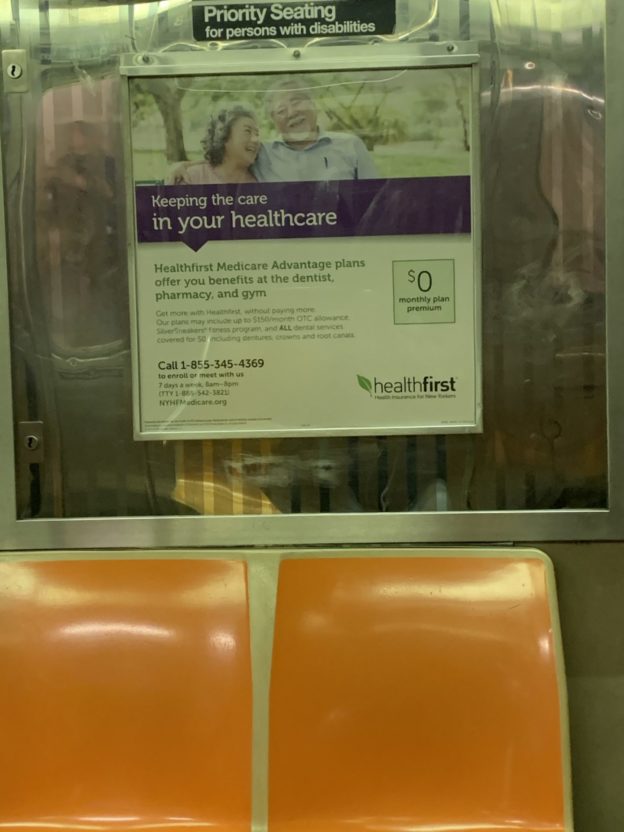
The speaker of the Healthcare ad would be a health insurance department called health first. The speaker is trying to present themselves by trying to persuade people who live in New York City to apply for Health first Medicare. I know this because it provides a number and email for people to reach out to for in case they want to enroll. Also, they talk about what they’re plans is going to consist of.

The line that says “Our plans may include up to $150/ month OTC allowance. SilverSneakers fitness program, and ALL dental services covered for $0 including dentures, crowns, and root canal”. The ad is trying to convey that if you apply for health first, you’re going to receive financial benefits when it comes to your health. They’re trying to also say that you’re going to be paying less than what you would expect.

The intended audiences of the ad would be those who don’t have insurance and for people who do have insurance but doesn’t receive any benefits. Lastly, it’s intended for those who live in New York City. I know this because in the bottom of the ad towards the right, it says ” health insurance for New Yorkers”. So this insurance is not eligible to those who live out of state. In addition, it even persuades the audience from the subtitle by mentioning the benefits of the insurance which includes the dentist, pharmacy and gym.

The strategies that the author uses was providing the picture of the elderly couple to demonstrate how happy they are to be using the insurance. It shows how the insurance actually works. Also, if you probably get it at a young age it can actually last you up to when you become older.

The ad appears more to the use of logos to persuade the audience because it provides more factual information so it can convince people into enrolling into the insurance. For example, even though it doesn’t provide a lot of information, it provides numbers, websites, and a email for you to contact so you can find out more. The ad itself doesn’t leave anything out to make readers confused especially since it’s about your health. The reader even makes it specific as to who the ad applies to which is New Yorkers.

I think that the ad is not effective because even though it’s specifically for people in New York, there has to be other eligibility requirements. Also, I feel as if the benefit plans are very vague and needs to be more explanatory so people know what to expect. Lastly, I think that there’s always a catch especially when it comes to insurance and that it’s just not always beneficial.

Follow up from Class 10/2

First, a response from my aunt to your messages to her. 🙂

Because people mostly weren’t taking notes during the game, I added my own observations to the google doc—take a look to see how ethos, logos, and pathos apply to some of your own persuasive techniques.

Final Project Proposal Instructions

Proposals Due: Monday October 21st (via email or handed in during class)

Often, both academics and writers outside of the university do not just write an essay and submit it. Journalists pitch article ideas to their editors, and others might need to propose a topic before getting approval to write it.

For example (and this is 100% true), I recently applied to be part of a collection of essays about the TV show Riverdale, but I didn’t need to write my entire essay first. I sent them a proposal describing what I intended to write about, and only if I was accepted (I wasn’t) would I need to write the entire essay.

What does a proposal look like?

  • A proposal is typically about 2 pages, although it can be slightly longer
  • You can use “I” (like “I plan on investigating ______”)
  • Use a formal academic style (1 point)

What should you include in this proposal?

  • The general topic you are interested in researching and writing about (1 point)
  • Two or three “inquiry questions” relating to your topic that you would like to research/answer/find out more about. (2 points)
    • These should not be questions you already know the answer to, although you can have a hypothesis about what the answer will be.
    • They should also be specific, focused, and answerable/arguable within the  scope of the assignment
  • A justification for why you chose your topic and why these inquiry questions are worth investigating (2 points)
  • Explain which of the inquiry questions you will probably choose for your paper and why (although it’s okay to change your mind in this early stage) (1 point)
  • A research plan (1 point)
    • What do you need to find out in order to answer your inquiry question(s)?
    • What information is important to find out first before you investigate other aspects of your question(s)?
    • What stumbling blocks do you anticipate in your research?

 Grading

Meeting the Above Requirements: 8 points, distributed as noted in the guidelines
Turning the Proposal In On Time: 2 points
Total: 10 points

What is an Inquiry Question?

An inquiry question is something you genuinely do not know the answer to but would like to find out. It must be complex enough to require research and careful thought. Generally, you should avoid questions with simple yes/no answers. “How…?” “Why…?” and “In what ways…?” questions are typically better.

You’re allowed to have a hypothesis about the answer to your inquiry questions, but you should also be open to being wrong.

As you develop your questions, think carefully about scope. If your question is too big/broad, it will be impossible to answer it between now and the end of the semester, and impossible to describe your research in only 6-8 pages. (Some inquiry questions are so big that they require years of research and entire books or series of books can be written about them!). If your question is too small/specific, you will have trouble finding enough to write about. What seems feasible for you to:

  1. Research thoroughly so you have a solid (although beginning) understanding of the issue in only a few weeks
  2. Write about in a coherent and comprehensive way again in only a few additional weeks

An example of a too-big question: Last year, I had my students write a more substantial rhetorical analysis essay than I’m having you do for your “analysis of an ad” projects. One student’s inquiry question was essentially, “What’s up with Trump’s rhetoric?” That’s WAY too big of a topic for one essay! Trump says more things all the time! I encouraged him to just pick one speech or one set of tweets.

Analysis of an Ad Assignment

Original Post Due: Monday 10/14 by end of day
Comments To Your Classmates Due: Wednesday 10/16 by end of day

For this assignment, you will take a picture of an ad or other poster that you see out in the world. We’re in NYC– there are ads everywhere. You may not use an ad we have already analyzed together in class, and you may not knowingly use the same ad as a classmate.

While it is possible to use WordPress on your phone, I strongly suggest you use a computer to write your post, especially if you have never used WordPress before.

Part 1 Instructions

After you find your chosen ad, do the following:

  1. Write a blog post on our course site following the Posting Directions. Embed the picture of your ad using the “Add Media” button.
  2. Under your picture of the ad, write a rhetorical analysis of your chosen ad. It should be the equivalent of about 2 pages of size 12/double spaced writing in a word processor.
  3. Before you post, find the “Categories” section in the right-hand sidebar of the post editor. Choose the “analysis of an ad” category. Then also find the “tags” section in the right-hand sidebar and tag the post with your name.
  4. Hit the blue “Publish” button.

If you have questions about WordPress/how to post, you can email me or leave them in a comment on the “Instructions for Posting” post–that way, your classmates can answer you as well as me.

Some guiding questions for your analysis:

  1. Who is the speaker in the ad? How is the speaker trying to present themselves? How does the speaker want you to view them? How do you know?
  2. What are the messages/arguments that the ad is trying to convey?
  3. What assumptions does the ad rely on?
  4. Who is the intended audience(s) of the ad? How do you know?
  5. What strategies does the ad use to try to persuade the audience?
  6. How does the ad appeal to ethos, logos, and pathos to persuade the audience?
  7. Do you think the ad is effective? Why or why not?

Part 2 Instructions

Choose (at least) two classmates’ posts to respond to with comments.

In your comments, you must add to their analysis of the ad. It is not enough to simply agree with their take and compliment them on it (although you can do that too!). Adding can mean disagreeing with their interpretation and explaining why, or it can mean offering additional interpretations even if you think their take is valid:  “Another interpretation could be that the argument is _________, because if you look at _________, maybe that means _________.” Or, you can analyze some aspect of the ad that your classmate didn’t talk about in their post!

Always support your analysis with evidence.

Each comment should be the equivalent of at least half a page of (size 12 double spaced) writing.

Vote on Rhetorical Devices Assignment

Please vote here. This will be a participation grade.

Vote on Rhetorical Devices Assignment

    I describe both versions and their pros and cons here: https://eng101owood.commons.gc.cuny.edu/rhetorical-devices-assignment/

Getting To Know You Survey

Dear Writers,

Please fill out the form below when you have a moment. All of your answers will be private.

Thanks!

Olivia

Getting To Know You

While we will do group introductions on the first day of class, this form will give you the opportunity to share information you may want to keep private.

  • If your name in CUNYFirst is different from the name you go by, please provide your CUNYFirst name and the name you actually use. I will only use the name you actually use-- this is just so I know which person matches which roster name.
  • You can use IPA notation if you know it, but you can also use rhyming words or just spell out sounds as best you can. Example: Olivia Wood: O as in Ohh// Li as in Lizard// Vi rhymes with Bee // A like Uhh// Wood rhymes with Good
  • For example, I use she/her/hers pronouns. That means if you're referring to me, but not using my name, you would say "she." "My professor's name is Olivia. She sent us an online form to fill out."
  • This could include accessibility concerns and/or learning accommodations (no documentation required), life factors that may affect your ability to attend class or turn in assignments on time, etc.

Instructions for Posting

  1. If you are signed in to your Commons account, you should see a menu at the top of the page that has a button reading “+ New” , Click on this button to write a new post.
  2. Write your post! You can write in either the Block editor or the Classic editor. I like Classic better, but choose whichever one you find easier.
  3. If you’re in Classic editor, find the “Categories” section of the righthand sidebar (not “Category Sticky”) and select the appropriate category or categories for your post. If you’re in Block editor, toggle to the “Document” tab of the sidebar instead of the “Block” tab and do the same thing. You should never select “Instructor Announcement” as your category, because that’s just for me!
  4. Add tags to your post. Tags should include your name (or username, if you don’t want to use your real name), as well as any other tags you want to use (such as topics addressed in your post). Once you decide what name/username tag to use, ALWAYS use that tag for all of your posts! This will make it easier to view everything you’ve written.
  5. Choose privacy settings for your post. Our site is already semi-private. Only members of the Commons can see it. However, if you want to make it MORE private, you can. A “public” post is visible to any Commons user. A “private” post is visible only to members of our class. A “password protected” post is the most private. Only you, me (as an administrator of the site), and people you share the password with can see it. Use this option if you’re posting material you don’t want your classmates to see, such as if you’re writing something personal.
  6.  Check or uncheck the “send to group” option in the “Group Blog” part of the sidebar. If this is checked, everyone in our class will get a notification email about your post.
  7. You can choose to set a “featured image” for a post. That image will appear at the top of the post and be included in the “link preview” that appears when you share the link on social media. Only do this if you want to.