
Category Archives: Posts
A meme for your enjoyment

Halloween Extra Credit: Olivia Wood

I thought it would be best if I lived up to my own assignment this time! This Halloween, I dressed up as my friend Maddie because she already owns the goth aesthetic I aspire to every Halloween, and it was a low-effort Halloween costume while still being creative and not a cop-out idea. Maddie loves cats, unicorns, stickers, and sparkles, and she is a professional poet, so I’m wearing cat ears with a rainbow unicorn horn, painted my nails sparkly, and I have stickers and silly Halloween poems that I wrote to hand out to people. Maddie is a great person, a great writer and artist, and a great friend, so she is definitely someone I aspire to be more like.
 My original idea for Halloween was to be Garnet from Steven Universe in her wedding outfit. I love Steven Universe for its wholesome, loving themes, queer representation, and abundance of kickass women. And aliens! I relate to Pearl the most personally, but I love how Garnet’s outfit combines both a suit and a dress (masculine and feminine dress). I alternate between whether I like suits or dresses best depending on the day, so seeing Garnet combine both made me happy.
Note: You don’t have to write as much as I did, but you’re welcome to!
Annotated Bibliography
Due: Monday, November 18
For a Word Doc version of this assignment sheet, click here: Annotated Bibliography Assignment .
Instructions
- As you research your inquiry question for your final project, compile a list of sources (bibliography) that help you answer your question and/or provide useful background knowledge for you and your readers.
- Cite each source according to APA style.
- Below each citation, write a paragraph or so about that source (an annotation). The paragraph should include:
-
-
- A summary of the source
- Your thoughts on the source (How do you think you will use it in your paper? What bias do you think it might have? What are its strengths, and what are its weaknesses?)
- A reminder to yourself of anything else you want to make sure you remember about the source
-
Other Guidelines:
- At least 6 sources + annotations
- In addition to writing each citation in APA style, you should also include these other aspects of APA formatting: title page with title, name, university, and any author’s note you want to include, correct running head on all pages, page numbers, correctly titled References page
Grading:
Each source + annotation includes all required parts (4 points per entry = 24 points)
Every other element of APA style listed above is met: 9 points
Turned in on time: 2 points
Total: 35 points
Halloween Extra Credit Opportunity
Because Halloween is a Thursday this year so we will not see each other and get to talk and write about Halloween and its rhetorics/meanings, I wanted to offer you an extra credit opportunity for Halloween instead.
And we’ll be doing it as a cross-college collaboration with my friend and colleague Eric Dean Wilson’s class at Queens College!!
What To Do (Part 1)
On or near Halloween, write a blog post on our course site that includes 1) a photo of you in your Halloween costume and 2) some writing about what your costume means to you. The writing can be rhetorical/analytical, or argumentative, or personal narrative, or really any other mode you choose. Tag your post “Halloween”
If you don’t have a Halloween costume or don’t want to write about yourself, you can also post a photo of a friend or family member in their costume and interview them for the writing instead.
If you don’t celebrate Halloween, you can post a photo of your choosing and write about your relationship with the holiday as someone who does not celebrate it.
(This part enables you to earn up to 2 extra points in either your participation grade category or your rhetorical devices category, whichever will benefit you more)
What To Do (Part 2)
On Halloween or in the few days after, visit Eric’s students in their Instagram hashtag (#fa19eng110), read their posts, and respond to several of them, answering the question, “What did their post make you think about?”
Also respond to any/all comments they leave on your blog post.
(This part enables you to earn up to 2 points in your participation grade category only.)
Some Examples of Final Portfolios (in Progress)
While we will talk about this more on Wednesday during our computer lab session, I wanted to share with you some examples I found of final portfolios (in progress) by John Jay students in other English 101 classes.
Many classes use Digication for their portfolios, and you can search the John Jay Digication page for way, way more examples of current and past student portfolios!
John Jay Digication Database: https://johnjay.digication.com/portfolio/directory.digi
Some examples of current English 101 portfolios in progress.
https://johnjay.digication.com/jesus-robles-eng-101-fy02/home-1
https://johnjay.digication.com/leslie-pelchor-eng-1014/home-1
https://johnjay.digication.com/asadbek-alijonov-eng101-fy19/welcome
We will not be using Digication, but CUNY Commons/Wordpress instead. This is because while Digication is specifically designed for ePortfolios (and therefore probably easier), it’s also really only designed for use in schools. WordPress is the platform behind about 30% of the entire internet (the CUNY Commons is just one network of websites that uses WordPress), so more practice using WordPress will give you a much more marketable and personally useful skill.
(Personally, I’ve used WordPress in 3 different jobs so far, including teaching at John Jay, and I used to use WordPress for my personal website until I rebuilt it.)
CUNY Union Updates and How it May Affect Students
At the beginning of the semester, I told you that CUNY’s union was in the middle of contract negotiations, and that it was possible we would go on strike before the end of the semester. As of right now, I think that if a strike happens, it is more likely to happen in the spring than this semester, for reasons I will explain below.
But I wanted to update you on what’s going on, since the working conditions of CUNY faculty and staff impact your lives in various ways, and the funding of all of this definitely impacts tuition costs.
Additionally, about a quarter of all jobs in New York (the state, not the city) are union jobs, so it’s likely many of you will be represented by a union at some point. So, it can be helpful to learn a little about how these things work.
Yesterday, the PSC (that’s the name of the union, it stands for Professional Staff Congress) released what’s called the Memorandum of Agreement. Basically, it outlines all the stuff the bargaining team and CUNY management (along with the governor and the NYC mayor) agreed on.
For the next two weeks, each college is having meetings for members to discuss the contract, ask questions, and decide how we feel about it. On 11/7, the Delegate Assembly (that’s like the US Congress but for our union) will vote on whether or not to accept the contract. If they vote yes, then all the members get to vote on it, so the contract becomes real/official only if the members approve it.
Relevant Aspects of the Proposed Contract
- Everyone gets a 2% raise each year (any raise is better than no raise, but because inflation is higher than 2% and the cost of living in NYC tends to go up even more than that each year, even though we will have higher numbers in our paychecks, our “real wages” (what your money can actually buy, your purchasing power) will still go down. So essentially we will have less money.
- At the end of 2022, all adjuncts who don’t already make this much get a bigger raise at the end of 2022, resulting in $5500 per course. (Right now a brand new adjunct makes $3200 per course, and people who have been teaching longer make more.) Even with these raises, most adjuncts would only make about $42,000 per year at that point if they work full time (right now it’s more like $30,000). That is already not a lot of money to live off of for NYC, but it’s also hard for adjuncts to even get hired for as many classes as they want, because CUNY is offering fewer sections of classes than in the past because of budget cuts.
- Adjuncts will get paid for office hours, but they will also be required to hold office hours every week. So it’s more money, but for more required work. So it’s not really a raise.
- No additional funding is provided by the state or the city
What Does This Mean For You?
Well, first, it means just about all of your teachers (and advisors, and other CUNY staff you interact with) will be poorer relative to the cost of living than we already are. Money stress = less time and less emotional energy to put toward teaching.
But more importantly for you, they (CUNY administration) will probably raise your tuition to make up the difference. Governor Cuomo and Mayor deBlasio did not promise any additional funding from the state and the city, which means that in order to pay for the things in the contract (which aren’t even that good!), it has to come from either student tuition or budget cuts to existing things. Which means fewer resources for you.
For example, Nic was talking to me yesterday morning about how the ACE advisors have no space in their schedules to meet with students–because there really aren’t enough advisors to actually have time to give every student useful advice. Budget cuts would just make problems like that worse, not better.
What Happens Next?
Right now, everyone is arguing about whether or not the delegates should accept the contract and trying to convince each other. On 11/7, the delegates vote.
If they vote no, the contract has to be renegotiated.
If they vote yes, then the membership will vote on it sometime soon after, but with time for more discussion (my guess is the vote would be before Thanksgiving).
If membership votes yes, then the contract becomes official. I don’t know what the next step for activists will be if that happens.
If membership votes no, then the union bargaining team goes back to renegotiating the contract, and we will try to get the union leadership to call for a Strike Authorization Vote and get people to vote in favor of striking. I don’t know how long that process is likely to take.
What Can You Do?
If you want to get involved with these issues, there are a couple different things you can do.
- Talk to your teachers about these issues! Even if that’s just asking what they think about it and listening to them. More discussion = more engagement, and more engagement makes the process more democratic and informed. Also, the more people are involved and knowledgeable about the situation, the more the administration will need to make real concessions, because if people are paying attention, they know people will be pissed if they try to screw us over.
- Check out Free CUNY, an activist group that includes students. They have a lot more information on these topics and how they affect students, as well as how you can get more involved with different things going on.
If a Strike Does Happen at Some Point, What Does That Mean for Students?
Like I said, a strike might not happen at all, and if it does, I don’t know when. But that’s also definitely the most exciting part of all of this, even if it is only a maybe, so I wanted to talk a bit more about it.
A couple different things.
- It means any of your teachers who are striking will not be holding regular class. So you could just stay home until the strike is over.
- However, you can also join teachers on the picket line to add support to the strike.
- Some teachers might hold “teach outs,” where your class meets but on the picket line itself to use the labor struggle as a learning opportunity. (For example, if I was going to hold a teach out, I would ask all of you to make a protest sign for a CUNY-related issue of your choosing, and then write a short rhetorical analysis of why you designed your protest sign that way. Then while we were protesting, we would talk about the rhetorical strategies other people were using.)
- Even if you have a teacher who is not striking, you can go on strike yourself! That doesn’t just mean skipping class, but telling your teacher and your classmates that that is why you are not attending, and joining in strike actions (like marching or picketing).
Medical Algorithm Routinely Underestimates the Needs of Black Patients
Analysis of Ad: Alexis Enanian
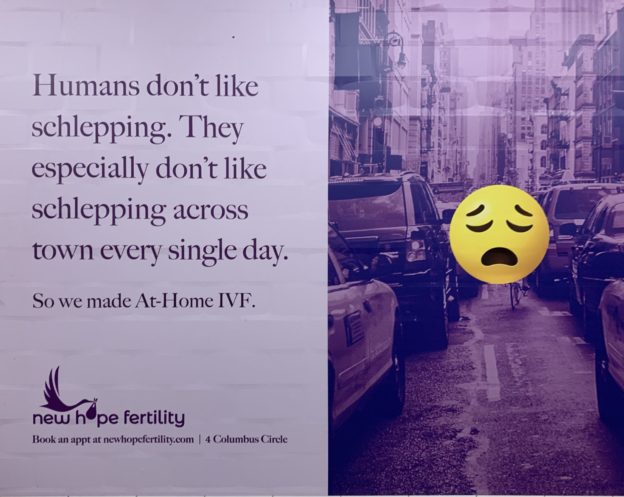
The speaker of the At-Home IVF ad would be the fertility company, New Hope Fertility. The speaker is promoting their business and presenting themselves by persuading city goers to consider this “at-home ivf”. Im aware of this because the ad cover is an “emoticon” of a tired face placed upon a city commuter, while it states how no one wants to schlep across town all day.
Given in the AD it states that the reason why “At Home IVF” was made was because no one wants to be carrying on all day and “schlepping across town”. The ad is clearly stating the message that with this fertility test, it will make your life easier without the hassle of walking across town from work or home because life is hard enough. Guaranteeing a more peaceful experience with their IVF.
The intended audience for this ad, clearly are busy people who don’t have much time on their hands to go for these fertility tests. Its meant to attract women and men who are in New York city who don’t have the time to “schlep” around the city as they already do so much. With this ad, it focusses on the relaxation and almost ‘sympathizes” for these New Yorkers who have a tight schedule. I know this because in the image given, it is a photograph of an obvious NYC commuter in the streets.
The strategies used in this ad is the image of the traffic and commuter in the middle with the emoticon of a worn out facial expression to depict the image of how “jammed up” and tiresome life is, especially in the city, This offers people the at home experience to avoid the extra “schlepping” words like that are used to describe the feeling of people who carry and haul everyday and who are exhausted. Including the line of “so we made at home IVF” this shows that the company genuinely cares for New Yorkers and has their best interests at heart.
The ad appears to use a lot of pathos, to sympathize and show New Yorkes that they understand and with an important situation of fertility they can make a situation like this a lot easier for us, Although it doesn’t provide much logos or ethos, the understanding with the use the image does play a role to persuade people that this company understands the importance of fertility but not all have the time for it. In serious matters the ad conveys the message that with this understanding they took it upon themselves to make this chore not much of a chore but a time to wind down and to allow you to stay home
I believe the ad lacks more methods to lure in New Yorkers to consider their offer yet i feel like they did come across well with their choice of image to show that they understand. i think the use of the sentence “so we made at home ivf” shows us commuters that this ad understands and genuinely does want to make our lives easier. It has some effect yet lacks a lot of ethos in order for me to trust this serious personal issue to be well and effective at home,and proven to do a good job with the use of logos.
Analysis of Ad: Ajmayen Syed
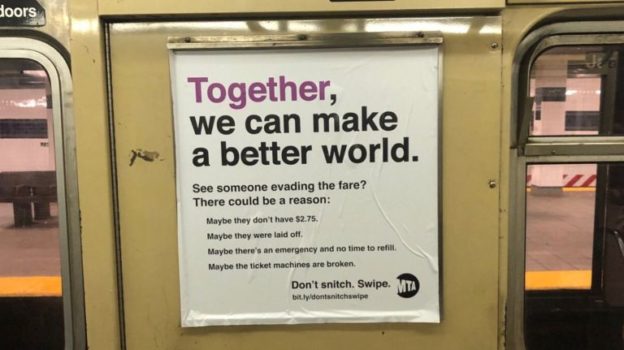
The speaker of the ad are the board members and head directors for the MTA. The speaker is trying to present themselves as people who don’t like to penalize for mistakes. By saying “Don’t snitch” it shows us that the speaker is trying to show us that they don’t believe snitching will change anything. They want to “help” us in a way.
The message that the ad is trying to convey is that you should not say anything if someone hops or passes through the MTA swipe areas. People go through tough times so they most likely have a reason for doing what they did. Also when they say “Don’t Snitch. Swipe” it means you should just try to help the person instead of ratting them out. By listing out bullet points of why a person most likely did not swipe, tells us that the MTA believes that people do not pay when they do not have the resources to get past. They want us to believe that doing so is okay however there are some things that do contradict what they are trying to say.
The intended audience for this ad would be the people in NYC who take the MTA. I know this because it’s telling the public not to snitch but rather help people who are trying to get past. They know that people have seen this several times and most likely people did have valid reasons in doing what they did so they just want people to know to help out instead of causing more hardship on people.
The strategies used to convey and persuade people would be the fact that they put up, reasoning into why people should help, and the color difference on the word “together” and the word choice of “better… world” help play a role in persuading people into taking action and try following what they are trying to say. Ethos is used when it says “MTA” on the bottom of the ad. This shows that this ad is credible and they MTA is trying to push forward what they are trying to say. Usually when you see MTA it means you follow what they say and in seeing that they put their credibility on the ad shows they are okay with people following what is being conveyed. Pathos is used as well when they list out the reasons why a person did not swipe. The list that they have created also consists of a lot of pathos because nobody wants to cause hardship to people who “laid off” or have “an emergency”. So the points that they listed play a role in using pathos effectively. Logos is used when they say “don’t snitch, Swipe”. They want people to help instead of causing more problems and when listing the bullet points first and saying that after, shows logically why people should help out.
I believe the ad is effective because I myself have experienced this first hand. Even my friends have. When we go somewhere we swipe for each other or just hop over because we don;t have the money and are just trying to get somewhere. Instead of having someone snitch i do feel it would be better if I received some help to get to where I am trying to go

